
–The Trams–
I’ve written hundreds of poems, and only a few have been published. But the unpublished ones, even from childhood, are still dear to me. They are also all sing-songy, with meters than mimic poetry I was reading at the time. Here is a limerick I wrote at age 9:
There once was a mom from France,
Who learned an Irish dance,
And pranced to the mill,
But fell down the hill,
In the midst of the King’s plants.
Along with excessive use of commas, I was experimenting with different forms and trying to find my writing voice. I imagine young Agatha (age 10) doing the same in 1901 when she wrote a poem the day the Western tram system came through Ealing, connecting the suburbs of west London to city life. This poem was published in an Ealing local paper, but has not resurfaced. Agatha recalls the first stanza in her Autobiography, but she could not remember the rest:
“When first the electric trams did run
In all their scarlet glory,
‘Twas well, but ere the day was done,
It was another story.”
The ominous “it was another story” perhaps points to the dirtiness of the tram at the end of the day, or the locals’ dissatisfaction at the noise and bustle it brought to Ealing. Whatever the case, the first (known) work she ever wrote was a poem, it was published, and then it mostly disappeared. I think we writers like to know that even if our writing doesn’t survive, it still matters: a tree falling in the forest still makes a sound and all that.
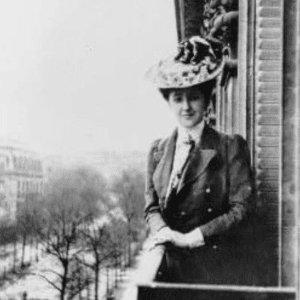
What followed “The Trams”1 were a string of unpublished works, written from ages 18-20 years old:
- Being So Very Wilful (short story)
- Snow Upon the Desert (novel)
- The Conqueror (play)
- In the Market Place (short story)
- The House of Beauty (short story)2
What is most impressive about this lineup is that Agatha continued to write and submit her works for publication, despite rejection letters. Like many readers of her work, my “gateway drug” into the canon were the Poirot novels, but I want to explore her short stories, poetry, and other works as well. I cannot think of another writer, save maybe Oscar Wilde, who was fluent in such diverse writing styles. I have come to accept that poetry is the language I write in–my attempts at fiction start to rhyme or are too philosophical when attempted.
Agatha played around with pseudonyms for these early works, using “Monosyllaba” (no doubt a joke) for “Snow Upon the Desert,”3 and “Sydney West” for “The Conqueror” and “In the Market Place”. Avid readers will notice that she must have liked the last name “West,” as Raymond West is a mystery novelist in the Marple novels; her grandmother was also named Mary Ann West, so this may be a small tribute. In any case, Raymond West has to be one of my favorite names in fiction—it has a ring of authority and whimsy to it, which Raymond the character lives up to.
Because these works were unpublished, there is little more to say. But I wanted to make a note of them, as I will with the few unpublished works left in her cannon. At the very least, they show that even Agatha Christie faced rejection and developed her style over at least a decade.
- Name designated to poem by Christie biographer J.C. Bernthal. ↩︎
- “The House of Beauty” was unpublished in its first form but was later converted into “The House of Dreams” and published several years later, so I will cover that more in a later post. ↩︎
- This should be disambiguated from “Snow Upon the Desert,” by Scottish writer Sarah Macnaughtan, published in 1913. As far as I can tell, the content of her novel bears no relation to Christie’s work. ↩︎
 The Agatha Project
Leave a comment